News

Wednesday, April 24, 2019
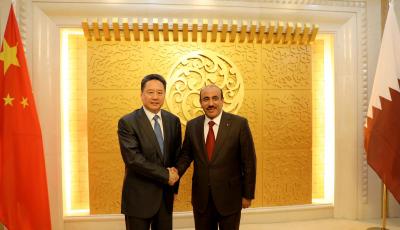
Minister Meets with Chinese Counterpart

Beijing – ChinaHE Minister of Transport and Communications Jassim Saif Ahmed Al-Sulaiti, who is currently on a working visit to China, held talks with his Chinese counterpart Minister of Transport HE Mr. Li Xiaopeng.The two officials discussed several topics of common interest relating to transportation and mobility and means of further enhancing them. They also discussed means of increasing cooperation in the Belt and Road Initiative (BRI) and seizing new potential investment opportunities in both countries.The meeting was attended by HE Ambassador of Qatar to China Mr. Sultan bin Salmeen Al-Mansouri.

Sunday, April 21, 2019
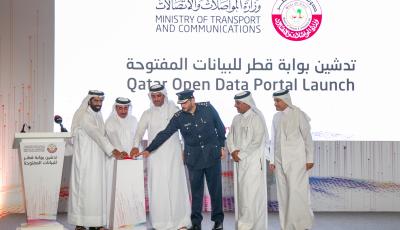
Minister Launches Qatar Open Data Portal

Doha – QatarHE Minister of Transport and Communications Jassim Saif Ahmed Al-Sulaiti today launched the Qatar Open Data Portal at an MOTC event attended by the Planning and Statistics Authority Chairman HE Dr. Saleh bin Mohammed Al Nabet and the Administrative Control and Transparency Authority Chairman HE Mr. Hamad bin Nasser bin Rashid Al Misned Al Mohannadi.In his opening speech, Minister Al-Sulaiti said that as the Government of Qatar realizes the importance of open data, “the Ministry of Transport and Communications launched the Open Data Policy in 2014 to achieve the objectives of national development and Qatar National Vision 2030. The aim is to provide public services efficiently and transparently, build the knowledge-based economy and boost innovation and creativity through an open and transparent culture where knowledge is available and accessible.”“In light of our work toward building a smart nation and our commitment to raising the name of Qatar in all global rankings where government transparency is a key factor, I am pleased to launch the Qatar Open Data Portal today, which will be a gateway to government data, making information easy to access, share and reuse. This will help transform these data and information into tools and applications that help in areas of research, innovation and creative and smart solutions,” he said.He said it was important to release data and make it open given the social and business value of doing so, “because data is a fundamental resource for the knowledge society that we aspire to and one of the powerful catalysts for trade progress and economic growth.”He hailed the MOI initiative in the field of open data, and efforts of the Ministry of Finance and Planning and Statistics Authority, which took the lead and began sharing their data via the new portal.He said he was confident all government entities would join the portal soon to contribute to building a government that is more efficient, more open and more transparent for the good of all.MOTC Assistant Undersecretary for Information Technology Affairs Mr. Hassan Jassim Al-Sayed said that MOTC launched this portal to publish government data online via a single national platform to streamline public access to data while guaranteeing its quality by making it available in the right format in line with best world practices.The success of this new portal, he said, “requires government entities’ cooperation as MOTC will be responsible for managing the portal with a specialized team that will focus on supporting all government bodies to raise awareness and encourage them to upload their open data to the portal.”“MOTC will also continue to organize workshops for open data ambassadors in each government entity, who have already been identified, to train them further in how to share their future executive plans as required at their entities,” he added.The event wrapped up with a panel discussion that included representatives from MOI, Ministry of Culture and Sport, the Planning and Statistics Authority and the Administrative Control and Transparency Authority for insights and exchange of expertise.Director of e-Government Programs & Standards at MOTC Ms. Mashael Ali Al-Hammadi said that in the future countries would not be ranked as rich or poor but based on scales that focus on knowledge and information and to what extent they apply knowledge, research, development and technology.

Sunday, April 21, 2019
Minister Meets with Tajik Civil Aviation General Authority Chairman

Doha – QatarHE Minister of Transport and Communications Jassim Saif Ahmed Al-Sulaiti met here today with the Chairman of the General Authority of Civil Aviation of Tajikistan HE Mr. Ikram Sobhanzadeh.The two officials discussed cooperation relations between the two friendly countries in the fields of air transport and the opening up of airspace for their national carriers.The meeting was attended by Qatar’s Civil Aviation Authority (CAA) Chairman HE Mr. Abdulla bin Nasser Turki Al Subaey and HE Ambassador of Tajikistan to Qatar Mr. Khisrav Sohibzoda.

Sunday, April 21, 2019
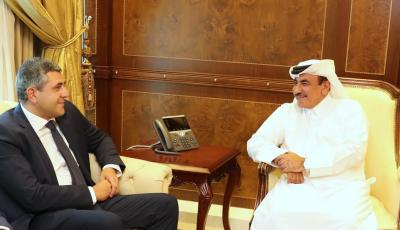
Minister Holds Talks with UNWTO Secretary-General

Doha – QatarHE Minister of Transport and Communications Jassim Saif Ahmed Al-Sulaiti met here today with the Secretary-General of the World Tourism Organization (UNWTO) Mr. Zurab Pololikashvili.The two officials reviewed the relations between the State of Qatar and the UNWTO in the field of aviation industry and means of further enhancing them.

Saturday, April 20, 2019
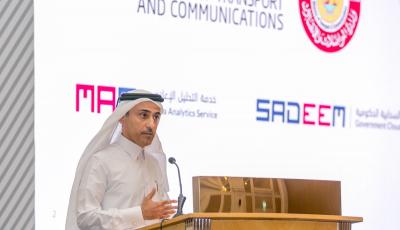
MOTC Launches Government Cloud, Media Analytics Services

Doha – QatarThe Ministry of Transport and Communications (MOTC) has launched the Government Cloud Service in association with MEEZA, and the Media Analytics Service, adding both of them to a list of shared services MOTC provides to government entities within the framework of Qatar Digital Government 2020.The first is a government cloud based Infrastructure as a Service (IaaS). It utilizes dedicated government network and focuses on delivering the service over a private and highly secure environment for government entities. This helps those entities to reduce cost on connectivity as well as improve agility. Through the cloud selfservice portal, IT administrators can create virtual servers in minutes in conjunction with MOTC to be compliant with global systems and standards.Media Analytics Service allows government entities to monitor, follow and analyze what is being published about them on social media and traditional electronic media, thus helping them monitor information and relevant published topics, follow up their indicators, measure public opinion, interact with them and identify potential crises for action. It will also help them in the preparation of the necessary reports in this regard easily and through dashboards provided by MOTC to service subscribers.“We are glad to launch these two new services as part of MOTC’s plans for achieving the strategic objectives of the Qatar Digital Government 2020 Strategy, which aims to create efficiency in government administration, maximize opportunities to make better use of public funds in accordance with the Qatar National Vision 2030 that aims to ensure fast and reliable accessibility to information technology with reduced operational and capital expenditures,” said MOTC Assistant Undersecretary of Government Information Technology Sector Mr. Hassan Jassim Al-Sayed.“The Government Cloud Service will provide a standardized virtual server that takes responsibility for configuration and operations of government entities' operating system (OS), software, and databases,” he noted. Processing, storage, networks, and other fundamental computing resources are now provided where entities can deploy and run arbitrary software, which can include operating systems and applications.“MOTC also provides the Media Analytics Service to government entities,” he said, “to allow them to follow up and analyze what’s being published about them on media, social media and the traditional electronic media, thus helping them to have instant follow-up of public opinion and deal with it properly. This, eventually, helps enhance interaction and online engagement between the public and government entities.”MEEZA CEO Eng. Ahmad Mohamed Al-Kuwari said; "We are glad to be a part of this launch. Among the main business benefits of Government Cloud —just as in other cloud offerings—is that it enables a level of agility not possible with traditional IT infrastructures that rely on in country datacenters. Further, being multitenant, this is both highly efficient and scalable, as well as cost-effective. Cloud computing services are compatible with MOTC’s national information assurance policies. They also follow governance mechanisms based on highest world standards such as ISO certifications for quality management and information defense, as well as the ISO20000, which is the international IT service management (ITSM) standard that enables IT organizations; whether in-house, outsourced or external, to ensure that their ITSM processes are aligned with business needs and world best practice. It also provides guidance on cloud computing services deployment and application.”In Feb. last year, MOTC and MEEZA signed an agreement per which MEEZA will provide government cloud and infrastructure services for government entities within the framework of achieving the goals and objectives of the Qatar Digital Government 2020 Strategy.

Monday, April 15, 2019
Qatar Ranks Third in Arab World on Global Cybersecurity Index 2018

Doha - QatarQatar has achieved high rankings in terms of cybersecurity and ranked third in the Arab world and 17th globally on the Global Cybersecurity Index 2018 released recently by the UN’s International Telecommunication Union (ITU).This year, Qatar advanced eight positions on the global landscape and occupied the 17th position, from the 25th in 2017.GCI 2018, which covered 175 countries around the world, placed Qatar with the top three countries in the Arab States region.GCI is an index developed by the ITU aiming to provide insight into the cybersecurity engagement of Member States. Rooted in the ITU’s Global Cybersecurity Agenda (GCA), the third version - GCI 2018 - still oversees the level of commitment in five areas: legal measures, technical measures, organizational measures, capacity building, and cooperation.GCI 2018 said “Qatar ranks third with a strong legal framework and a robust organizational structure with a National Cybersecurity Strategy (NCS) that has a key focus on securing critical information infrastructure and a National Cybersecurity Committee responsible to implement and drive that Strategy. Their eCrime law integrates a large arsenal of procedural measures.”GCI top ten most committed countries globally in 2018 included United Kingdom, ranked first, USA, second and France, third. Positions from four through ten went to Lithuania, Estonia, Singapore, Spain, Malaysia, Norway, Canada and Australia, respectively.GCI 2018 says that in 2018, the majority of countries reported having a national cybersecurity strategy, which is an increase from last year, and 47% have metrics to measure cybersecurity development at a national level, which is also an improvement, since in 2017 only 21% had metrics. It says that the overall result shows improvement and strengthening of all five pillars of the cybersecurity agenda in various countries in all regions.The GCI is included under ITU Plenipotentiary Resolution 130 on strengthening the role of ITU in building confidence and security in the use of information and communication technologies. The ultimate goal is to foster a global culture of cybersecurity and its integration at the core of information and communication technologies.The first GCI survey was conducted in 2013/2014 in partnership with ABI Research where a total of 105 countries responded out of 193 ITU Member States and the results were published in 2015.

TOP